
Posted by BNTECHGO on 27th Nov 2026
Indoor vs Outdoor Cables: How to Choose | BNTECHGO
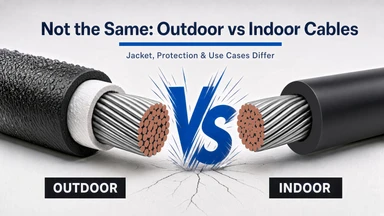
When selecting cables, many overlook a crucial distinction: although outdoor and indoor cables may appear similar, their uses and performance differ significantly. Choosing the wrong type can lead to insulation aging, short circuits, and even safety hazards. Whether in industrial automation, home circuits, outdoor surveillance, or precision equipment wiring, understanding the difference between these two types of cables is essential to ensure stable and safe system operation. This article explores the real differences between outdoor and indoor cables in terms of material structure, environmental adaptability, electrical performance, safety standards, and typical applications.
I. Environmental Adaptability: The Core Standard for Distinguishing Indoor and Outdoor Cables
1. Application Environment Determines Selection
Outdoor cables must withstand complex and harsh conditions, including UV exposure, rain, sand, mechanical impact, oil, and chemical corrosion.
Indoor cables are used in more stable environments, typically requiring resistance to frequent plugging, bending, and compact routing.
2. Weather Resistance and Protection Rating
Outdoor Cables:
- Made with high-durability materials like XLPE, FEP, PTFE, ETFE, and PU.
- Often feature multi-layer jackets, such as an inner silicone layer with an outer fluoropolymer layer, to enhance IP ratings (e.g., IP67, IP68).
- Must resist UV, hydrolysis, and corrosion—basic requirements for outdoor use.
Indoor Cables:
- Common materials include silicone, PVC, and FEP, emphasizing flexibility, flame resistance, and processability.
- Typically have single-layer insulation, making them easier to thread and install inside equipment.
- Suitable for enclosed or semi-enclosed spaces such as devices, electrical boxes, and laboratories.
II. Material & Structure: The Key to Cable Longevity and Reliability
Outdoor Cable Features:
- Materials: XLPE, PTFE, FEP, ETFE, PU.
- Advantages: High strength, abrasion resistance, UV resistance, aging resistance, water and oil resistance.
- Structure: Usually double or triple-layer jackets for enhanced mechanical and environmental protection.
Indoor Cable Features:
- Materials: Silicone, PVC, FEP.
- Advantages: Highly flexible, excellent insulation, flame-retardant, easy to install.
- Structure: Primarily single-jacketed, sometimes in ribbon or parallel form for dense and flexible wiring.
Conductor Structures:
- Stranded Conductors: Suitable for dynamic wiring and frequent bending (e.g., equipment connections).
- Solid or coarsely stranded conductors: Ideal for long-distance, fixed installation with higher current loads.
Note: The conductor type itself doesn’t determine if a cable is indoor or outdoor, but it must match the environmental and installation conditions.
III. Electrical Performance: Fundamental to Reliable Transmission
Regardless of indoor or outdoor use, electrical performance directly affects safety and efficiency. Common indicators include:
- Insulation resistance: Prevents leakage current and enhances system safety.
- Dielectric strength: Measures the insulation’s ability to withstand high voltage.
- Conductor resistance: Affects power loss and heat generation.
- Capacitance/inductance characteristics: Crucial for signal integrity and EMI resistance.
⚠️ Even if an indoor cable has excellent electrical performance, it is not suitable for long-term outdoor use if it lacks environmental protection.
IV. Safety Standards: Not Just Flame Resistance, But Also Environmental Durability
Indoor Cables:
- Typically meet flame retardancy standards such as VW-1 or FT1.
- Focus on material safety and environmental compliance to prevent toxic gas release under high heat or short circuits.
Outdoor Cables:
- In addition to flame resistance, they must pass UV, water, and oil resistance tests.
- Comply with IP ratings to ensure long-term stability in harsh conditions.
V. Application Comparison: Matching Cable Type to Use Case
| Application Scenario | Recommended Cable | Key Requirements |
|---|---|---|
| Solar PV systems | Outdoor Cable | UV resistance, waterproof, temperature resistance |
| Outdoor surveillance/lighting | Outdoor Cable | Sunlight protection, waterproof, dustproof |
| Smart warehouse wiring | Depends on location | Indoor for flexibility, outdoor for external runs |
| Industrial equipment (internal) | Indoor Cable | Flexible, oil-resistant, heat-resistant |
| Control cabinets / electrical boxes | Indoor Cable | Flame-retardant, easy to strip, flexible layout |
| Household appliances (internal) | Indoor Cable | Easy to process, heat-resistant, signal stability |
| Laboratory high-frequency equipment | Silicone / FEP Cable | Excellent electrical performance and EMI resistance |
Conclusion: Choose the Right Cable, Wire It Right, Use It with Confidence
Though indoor and outdoor cables may look alike, their differences in materials, construction, and performance are significant. Proper cable selection improves system efficiency and safety, extends cable lifespan, and reduces maintenance costs.
Quick Tips:
✅ Environmental adaptability is the top selection factor.
✅ Material and jacket structure determine durability and protection level.
✅ Electrical specs must align with real-world operating conditions.
✅ Safety standards should match the entire environmental and application scenario.
Whether you're building a solar array, upgrading an old system, wiring a smart warehouse, or equipping precision devices, knowing these core principles helps ensure a smart, safe, and efficient wiring decision.
Frequently Asked Questions: Indoor vs. Outdoor Cables
Q1: Can outdoor cables be used indoors?
A1: Yes. Outdoor cables have higher protection levels and can be used indoors. However, they may be thicker, less flexible, and more expensive—making them unsuitable for tight spaces or areas requiring frequent bending.
Q2: Can indoor cables be used outdoors temporarily?
A2: Not recommended. Indoor cables generally lack waterproofing and UV resistance. Even short-term outdoor use may lead to aging or failure. While silicone cables are flexible and heat-resistant, most have only single-layer insulation and cannot withstand direct outdoor exposure. If necessary, use protective tubing and sealing, and replace with proper outdoor cables as soon as possible.
Q3: How to determine if a cable is suitable for outdoor use?
A3: Check for jacket materials like XLPE, ETFE, PU, product markings like “UV resistant” or “Outdoor use,” certifications such as IP ratings, UL Outdoor Rated, and technical specifications provided by the manufacturer.
Q4: Are outdoor cables always more expensive than indoor ones?
A4: Generally, yes. Outdoor cables use high-performance materials and multi-layer designs, which cost more to produce. However, due to longer service life and reduced maintenance, they offer better long-term value.
Q5: What insulation materials are commonly used for indoor cables, and what are their suitable environments?
A5: Common indoor insulation materials include silicone, PVC, and FEP. Silicone cables are flexible and heat-resistant, ideal for tight spaces; PVC is cost-effective but less flexible and temperature-tolerant, suitable for general indoor use; FEP offers excellent thermal and electrical insulation, perfect for high-performance internal wiring.
Q6: Why is FEP used in some outdoor cables, but most FEP Teflon wires are for indoor use?
A6: FEP has outstanding heat, corrosion, and UV resistance—making it ideal for outdoor cable insulation. However, many commercial FEP Teflon wires only have a single-layer insulation and lack protective sheathing, so they’re not suitable for prolonged outdoor exposure. Instead, they are mainly used for precision indoor applications. Outdoor-rated FEP cables typically include multi-layer sheathing and are specially engineered and certified for durability and protection.
We hope this article helps you fully understand the differences between outdoor and indoor cables and avoid common pitfalls when choosing cables. If you have any questions or need technical support, feel free to contact our team. We are committed to offering the best solutions to help your project succeed.
For more information about our products and services, please email us at support@bntechgo.com, visit our website at https://bntechgo.com, or follow us on social media. We look forward to hearing from you.